
The gifts of a marquis-librarian
Among the various books that have come as gifts to the National Library, those belonging to Marquis Faustino Curlo (1867-1935), mainly dedicated to the figures of Christopher Columbus and Benvenuto Cellini, deserve special mention. After graduating in law from the University of Turin in November 1894, with a thesis on Silvio Pellico, Curlo embarked on a career as a librarian, entering the government ranks from April 1, 1898, as sub-librarian. Assigned to the National Library in Palermo, he was soon transferred to Turin, where he then carried out all his activities-except for some brief periods in Venice and Genoa-until his retirement in 1933. In 1900 he married Maria Pierina Peyron, niece of Abbot Amedeo, by whom he had two daughters.
After the January 1904 fire, Curlo was commissioned by then-director Carlo Frati to assist in the recovery of damaged manuscripts, succeeding with zeal and expertise in saving 1,843 membranous and paper manuscripts from certain ruin. In 1908 he obtained a diploma in archivistics, diplomatics and paleography from the School of the State Archives of Turin; while in 1911 he published for the Società Storica Subalpina the edition of the Memoriale quadripartitum of Friar Gabriele Bucci (1430-1497), dedicated to the origin and development of the town of Carmagnola and the birth of the local Convent of St. Augustine, with his sermons and funeral orations in honor of illustrious figures of that town.
In 1927 he was credited with discovering part of Count Giacomo Durazzo’s valuable collection of musical manuscripts, which had come by bequest from an heir to a Salesian college in the province of Alessandria; he then oversaw the search for and acquisition of the other part of the collection, still in the heirs’ possession in Genoa, which became the Renzo Giordano Collection. After Luigi Torri’s passing (May 8, 1932) he took over as director of the National Library of Turin, eventually giving way to Gino Tamburini in December.
A fine and amiable conversationalist, Faustino Curlo favored to entertain his interlocutors with erudite stories and tales of old Turin, about which he was well acquainted with anecdotes and events of the noble families who lived or had lived in the historic palaces of the city center, there where he himself lived at number 3 Porta Palazzo. A librarian by necessity, and certainly not by vocation, he had the soul of the noble Piedmontese of yesteryear, prone to erudition but reluctant to disseminate or worse, publish his knowledge. A member of the Italian Bibliographical Society from at least 1903 to 1911, he joined the Italian Library Association from its founding (1930), participating in its second national congress in 1932. He had also taken part in the First World Congress of Libraries and Bibliography in 1929. He was also a full member, since 1905, of the Piedmontese Society of Archaeology and Fine Arts, of which he was also librarian in 1917-1919, and a member of the Subalpine Deputation of Homeland History (correspondent since 1916, deputy since 1931), the Ligurian Society of Homeland History (since 1904) and the Société française des collectionneurs d’ex libris et de reliures artistiques.
He published rare scholarly, historical genealogical and bibliographical contributions (particularly on ex libris), and the inventory of the Capitular Archives of the Basilica of San Gaudenzio in Novara (1908).
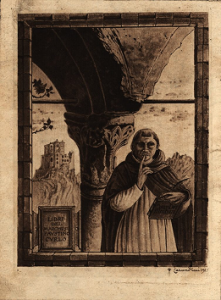
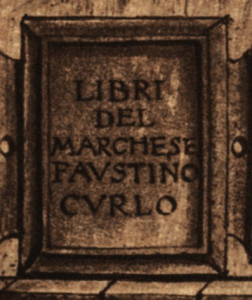
In the small town of Coazze, in Val Sangone, he loved to spend his holidays with his family, finding there the silence and tranquility necessary for his research into local history: an attitude well expressed by the ex libris he had designed for himself in 1925 by Marquis Francesco Carandini, in which the silhouette of the Sacra di San Michele della Chiusa soars between the arches of a loggia, while in the foreground a Dominican friar absorbed in meditation invites us with a hand gesture to be silent, accompanied by the motto “Vox Dei silentium.”